Blog Archive

Showing posts with label San Miguel de Allende Mexico. Show all posts

Sunday, September 15, 2013

Chicken, Leek, and Mushroom Mini Pies


Chicken, Leek, and Mushroom Mini Pies
by Victoria Challancin

Tomorrow is Mexico's Independence Day.  Usually, we have a three-day weekend, or puente ("bridge") filled with parades, barbecues, chiles en nogada (stuffed poblano chiles with meat and fruit covered in a walnut-cream sauce with pomegranate seeds), El Gritoand fireworks--lots of fireworks.  Living in the "Cradle of Independence," (i.e. the towns/cities of Dolores Hidalgo, San Miguel de Allende, and Guanajuato) where the first battles were fought and where independence was born, this celebration, like all Mexican celebrations, is particularly festive, colorful, and full of life.  This year, however, the festivities have been dampened by rain.  Rain, rain, and more rain.  Much-needed rain, perhaps, but rain nevertheless.

With Tropical Storm Manuel battering Acapulco and the West Coast and Hurricane Ingrid blasting Veracruz and the East, massive amounts of rain are flooding most of the republic, with San Miguel caught in the middle.  Far enough away to be safe from the winds, we nevertheless are experiencing extensive rain.  And severely dampened spirits--and trust me, it is hard to dampen the Mexican sense of joy and celebration.  Even my dogs have a case of the mulligrubs.

Hunkered down inside, dry and warm, my thoughts are turning toward comfort food, a blog post, and a recipe I made recently in a cooking class for Mexican students...Chicken Pot Pies.  Alright, they have been re-invented and renamed Chicken, Leek, and Mushroom Mini Pies and have been given a whiff of Frenchness, a soupçon of sophistication, but Chicken Pot Pies they are.  Nothing will disguise that.  Chicken Pot Pies filled with a wine-enhanced, cream-enriched melange of vegetables enveloped in a crust of puff pastry, made mini size in a muffin tin.  Yum.

It's almost embarrassing for a "professional" cook to admit to a love for chicken pot pies, but I do. Even the less than stellar frozen versions from childhood still hold a certain appeal.  Yep, it is embarrassing.  But to me, chicken pot pies will always be comfort food.  And this recipe is lovely--and perfect for such weather.

For a real Mexican treat, try my recipe for Chiles en Nogada, the National Dish of Mexico.  The green of the pepper, the white of the walnut-cream sauce, and the red of the pomegranate seeds lovingly represent the three colors of the Mexican flag.  The filling is made with a picadillo, or ground meat mixture that includes dried and fresh fruit--with candied cactus being the magic ingredient!

 The leek and mushroom filling

 In the muffin tin

Cook's Notes:  This recipe is perfect as written.  I added a bit more garlic...well, because I am half-Italian after all and just can't help myself.  Note that this dish can be used as a main dish or an appetizer.  Use a regular muffin tin, as I did, or mini-muffin size, just make certain to chop all ingredients even smaller.

Recipe:  Chicken, Leek, and Mushroom Mini Pies
(Recipe from The Illustrated Quick Cook, iVillage.com)
Makes 12 regular muffin-sized pies or 24 mini-muffin sized pies


2 tablespoons olive oil
1/4 cup butter
1 small onion, finely chopped
1 small carrot, finely chopped
1 celery rib, finely chopped
1 leek, finely chopped (2 1/2 - 3 cups, white and green parts)
1 garlic clove, finely chopped
8 oz (225g) mushrooms, coarsely chopped
1 to 1/14 lb (500g) skinless boneless chicken breasts, diced
1 tablespoon chopped thyme leaves
Finely grated zest of 1 lemon
1/4 cup dry white wine
1 cup heavy whipping cream
3 sheets read-rolled puff pastry
2 large eggs, lightly beaten
Sea salt and freshly ground black pepper
Mixed green leaves and herbs, for serving
Tomato relish, for serving (optional)

Preheat the oven to 400F (200C).  Brush a 24-cup mini muffin pan with olive oil (or use a regular 12-cup muffin tin).  Heat 2 tablespoons olive oil and the butter in a saucepan over low heat.  Add the onion, carrot, and celery, and cook for 5 minutes.  Add the leek, and cook until wilted.  Add the garlic, and cook for 30 seconds.  Add the mushrooms, and coon for another 5 minutes.

Increase the heat to medium.  Stir in the diced chicken, thyme, lemon zest, and wine.  Cook for 15-20 minutes, until cooked through.  Add the cream, and season with salt and pepper.  Continue to cook for 5 minutes, until the mixture starts to thicken.

For mini-muffin sized pies, cut 24 21/2-inch circles (6 cm) from the puff pastry.  Line each muffin cup with a pastry circle, and spoon in the chicken mixture.  Top each cup with a 2-Inch (5cm) circle cut from the remaining puff pastry.  Use large circles for regular a muffin pan.  Brush the tops with the egg, and slit with a knife.  Bake for 15 to 20 minutes, or until puffed and golden brown.  Invert the pans onto a wire rack.  To serve, scatter some mixed leaves and/or herb leaves over the top.  Serve with a tomato relish, if desired.  Serve immediately.


Parting Shots:  Berber "Figs"
 Called "Berber Figs" in Morocco, cactus fruit is often sold from carts on the streets.

In Mexico, both the cactus paddle (penca) and the fruit (tuna) are eaten throughout the country, but in Morocco, only the fruit is commonly consumed.  This display is from a vender's cart in Marrakech to show that the fruits are actually from a cactus and not a fig tree!  Can you tell I am gearing up to send out my newest Moroccan itinerary?


©Victoria Challancin.  All Rights Reserved.

Please ask permission before using photos or text.  Thanks!


Friday, June 21, 2013

Cantaloupe-Yogurt Soup with Ginger, Lime, and Mint


Oops!  I may have sent this one twice!  Sorry!


Cantaloupe-Yogurt Soup with Ginger, Lime, and Mint
by Victoria Challancin

The weather is hot.  The rains have not yet really started.  Life is languid.  All of these factors come together to scream, "Give me cool, refreshing, light food!  Now!"  And so I did, yesterday in class.

On Wednesday, I started a new eight-week cooking course designed for Mexican cooks who mainly work for foreigners and who want to learn international cooking.  Aside from gazpacho, cold soups don't really figure into the cooking repertoire of most of my students, which is why it is such fun to introduce them to something new.  And easy.

This soup, which some could argue would easily work as a morning smoothie, comes together in a snap.  Toss the ingredients into the blender, whir it around, check and adjust flavors, and there you have it:  a perfect entry into a warm-weather meal.  Or savor it as a perfect breakfast smoothie--that works equally well.

While scrolling around looking for the perfect chilled soup, I thought to check the Soup Chick's blog, where I often find inspiration.  This melon soup was perfect.  Now that the summery fruits are starting to come into the markets, I knew I could find good melons, and the rest I already had in my pantry or my garden.

Cook's Notes:  When my students asked if they could use other ingredients, I told them that honeydew or other orange or green melons would work well, as would mango or pineapple, or any combination. I did grate fresh ginger into the soup instead of using dried, simply because I love the flavor.  This soup was a definite hit!  I have written the soup as the Soup Chick gave it, with ingredients to serve two.  We used 2 melons and were thus able to triple the recipe.

Recipe:  Cantaloupe-Yogurt Soup with Ginger, Lime, and Mint
(Recipe from soupchick.com)
Serves 2
3 cups cubed melon
1/4 cup plain Greek yogurt or regular plain yogurt
1/8 teaspoon ground powdered ginger (I used 1/2 teaspoon grated fresh ginger for 2 servings)
Zest of one lime
Juice of 1/2 lime (I added more)
1 teaspoon agave nectar or honey
2 to 3 mint leaves (I used 9 for the tripled recipe)
2 to 3 basil leaves (I used 9 for the tripled recipe)
A pinch of kosher salt
2 to 3 tablespoons water if needed to thin the soup to desired consistency

Combine all ingredients except water in a blender, and puree until smooth.  Adjust consistency with water if needed.  Check and adjust seasoning to taste, adding more ginger, herbs, lime juice, and/or honey to suit your taste.  Serve chilled.


Melon History and Trivia
What's not to love about melons?  They are cooling, refreshing, juicy, and delicious--and available all year long, though they are clearly at their peak in summer.  As a child I thrilled to pick watermelons straight from my Grandpa's melon patch in Georgia.  And later in Florida, even as a teenager, I delighted to use them as a float  as we cooled them in the lake where I grew up before sitting on the dock to eat them with the juices running down our arms.  But then, as a young adult, I stumbled onto an expanded world of melons far beyond the three types I grew up with (watermelon, cantaloupe, and honeydew) when I traveled through specifically Iran and Afghanistan, where the varieties dazzled.  Or perhaps it was just the cooling welcomeness in searing heat.  Whatever, I still have an image fixed forever etched in my brain of a young donkey running in circles in a melon patch in southern Iran--as if he knew the delight of the fruit himself, as if he didn't know he would grow up to be a beast of burden.


A Few Melon Facts:
  • Melons belong to the Cucurbitaceae family, which includes gourds, cucumbers, and squashes
  • Botanically speaking, a melon is technically a berry
  • The word "melon" derives from the Latin melopepo, which comes from the Greek for "melon"
  • Originally melons came from Africa and southwest Asia, but by the end of the Roman Empire, they had appeared in Europe
  • In ancient China, archaeological data suggest that melons have been cultivated for over 5000 years
  • Spain introduced cucumbers, watermelons, and melons to the New World, though other cucurbits existed there already
  • The ancient Egyptians and Greeks also grew melons
  • The papaya, native to the Americas, is a type of melon
  • The cantaloupe has its origins in Persia and the neighboring Caucasian region
  • The cantaloupe, which was popular in ancient Rome, was first brought to Rome from Armenia in the 16th century (other melons existed there earlier than this)
  • The netted species of cantaloupe probably originated in Persia
  • Melons are rich in water, sugars, and fiber
  • Melons have a slightly laxative effect because of the fibers they contain
  • Melons are an excellent tonic for circulation and useful in the control of blood pressure
  • Melons are rich in vitamins A and C
  • Because of their high sugar content, melons aren't suitable for diabetics
  • Melons are very hydrating and quench thirst
  • A mask of melon flesh can be used for sunburn as the flesh will absorb heat from the skin
  • It is best not to store melons in the refrigerator, but rather keep it in a cool, dry place
  • In the past melons were eaten as a vegetable with salt and pepper (and I still love them this way!)
  • Early explorers used watermelons as canteens
  • Every part of a watermelon is edible, even the seeds and rinds
  • Some clame that the cantaloupe is named after a village in southern France, others say it comes from Cantalupo, Italy
  • Egyptian hieroglyphics feature melons as early as 2400 B.C.
  • During the Civil War, Confederate soldiers boiled down watermelons to produce sugar and molasses
  • Watermelon seeds can be roasted and eaten as a snack
  • Ancient Egyptians so revered watermelons that they were often placed in the tombs of kings
  • In Japan they have square watermelons
  • It takes about 10 to 15 visits by bees to pollinate melons
  • Cantaloupes do not ripen after being picked
  • Cantaloupes are called "rockmelons" in Australia and often called "musk melons" in the U.S.
  • I posted here a recipe for making an agua fresca, or fresh fruit drink, using only the seeds of cantaloupes


This Cantaloupe-Yogurt Soup is my entry for the inspiring and fabulous Nancy Lopez's YBR event for the month of June.
Parting Shot:  A Moroccan Door


©Victoria Challancin.  All Rights Reserved.

Like life and love, recipes are meant to be shared, but please ask permission before using photos or text.  Thanks!


Wednesday, June 27, 2012

Yogurt, Memories, and a Cold Russian Soup

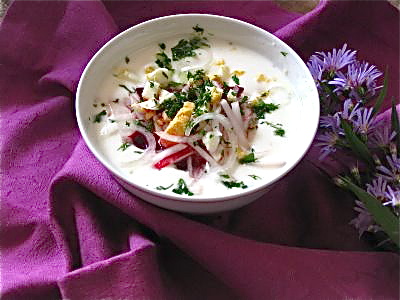
Cold Russian Okroshka Soup

Yogurt, Memories, and A Cold Russian Soup
(Recipe by Victoria Challancin)

I recently made a cold soup from memory, based on a Russian soup I had taught in a class a few years ago.  To offer it to you, I had to dig through my files to find the actual recipe and look around for an old photo I took of the soup as my new version wasn't as pretty.  As I did so, I smiled again at the process by which recipes travel, sometimes via the internet across continents to other worlds, sometimes through friends or fellow bloggers,  often through the family network, frequently as a result of travel.  This recipe represents most of these.

It all started with my love of yogurt and yogurt-type ingredients.  I love them.  Always have.  For many of my readers, it would be difficult to imagine a world without yogurt, kefir, buttermilk, and more, readily available in myriad flavors, in numbered cultures, from different types of milk.  From my early teen days when yogurt was a relatively new ingredient, at least in rural South Florida in the early 1960s with an electric yogurt maker that produced 6 or so tiny pots of yogurt that I could eat all at once, to travel days in Russia (where I drank everyone else's kefir at breakfast because I couldn't get enough--and no one else seemed to share my enthusiasm) or during my travels along the old Asian highway through Turkey, Iran, Afghanistan and beyond, where I ate fermented dairy products every day in many forms, to my years of living in the Middle East where the yogurts were incomparable, to our thoroughly modern world where all manner of cultured products are available practically everywhere. At every step of the way, I embraced cultured dairy products with gusto.

My recipe notes tell me that this version of Russian Yogurt Soup came from a site called www.diet.lifetips.com, though when I search it, I can't find the original source.  My notes also tell me that whoever put the recipe on that site, adapted it from the version in the utterly wonderful Russian cookbook Please to the Table, which I bought so many years ago after eating the Moldavian Vegetable Soup at my friend Lucky's house, made from a recipe in the book.  You see the thread?  Recipes really do travel.


The name okroshka comes from the word kroshit, which means "to chop" in Russian.  Traditionally the recipe is made with kvass or kvas, a beverage made from black or rye bread, but this recipe uses plain cultured yogurt or kefir because it is more readily available.  Most recipes that I found online contain meat, such as ham, sausage, or bologna and often contain mustard, vinegar, pickles, and cooked potatoes.  A Bulgarian version contains walnuts.  The variations are great.  I chose to keep it vegetarian and simple.


A Few Notes on Yogurt
Simply put, yogurt is a fermentation of lactose in milk caused by the lactic acid produced by certain bacteria.  These bacteria, found in a culture or in many cultures, produce lactic acid, which acts on milk protein to give it its signature texture and sour tang.

I may have only discovered it during my teens, but Neolithic herdsmen knew of it over 8000 years ago.  By milking their animals and carrying the milk in containers made from animal stomachs, the milk curdled due to the enzymes found there.  Historians tell us that Genghis Khan and his armies lived on yogurt.  Eventually, yogurt spread to Europe and beyond.

The Danone company is attributed with the first industrialized production of yogurt in 1919 in Barcelona.  However, it was an Armenian immigrant family who introduced commercial yogurt to American in 1929.  In 1947 Dannon, from the original Danone of Spain and later France, introduced in America the first commercial yogurt with fruit on the bottom.  We've come a long way from those early animal stomach bags of fermented milk.


A few interesting facts about yogurt:
  • Yogurt can be made from the milk of any animal, and depending on where you are in the world  it might come from cows, goats, water buffalo, mares, ewes, camels or yaks
  • Yogurt can be dated to the Neolithic peoples of Central Asia to as early as 6000 B.C., which makes it one of the oldest processed foods in man's history
  • The word "yogurt" comes from a Turkish word which means to curdle or to thicken
  • Although most languages retain the Turkish name, it is also known as yoghurt, yaourt, yoghurd, and yogourt
  • As early as 2000 B.C., yogurt was used as both a cleaning produce and a beauty lotion (the acid in yogurt helps clean away dirt and rust as well as dead skin!)
  • Yogurt contains the same amount of protein and fat as the milk it is made from, as well as riboflavin, vitamin B6, and vitamin B12
  • The domestication of cows dates to 9000 B.C. Libya, but it is accepted that the Central Asian Turks consumed mare's milk long before that, and possibly yogurt as well
  • Indian Ayurvedic scripts dating from about 6000 B.C. also refer to the health benefits of consuming milk products (but not yogurt specifically)
  • The cuisines that consume the most yogurt today are Turkey, Iran, and Lebanon
  • Yogurt became popular in the US after WWII (the Dannon company relocated there during the German occupation of Paris, where it had moved from Barcelona)
  • We know from Galen that the ancient Greeks may have known yogurt as "pyriate" 
  • Yogurt was known in France as early as 1542 (François I used it as a treatment for diarrhea)
  • Pliny the Elder wrote that certain nomadic tribes knew how to thicken milk into a substance with an "agreeable acidity--yogurt?
  • Other fermented dairy products include:  kefir, kumis, labneh, lassi, and shanklish


Cook's Notes:  This soup is really a salad in a bowl, filled in with liquid yogurt or kvass.  All of the ingredients should be served cold, whether presented as I do as a yogurt soup with separate garnishes or more traditionally, all stirred together.  This particular soup is often considered to be from Uzbekistan.

Okroshka:  Russian Cold Yogurt Soup
(Recipe from www.diet.lifetips.com)

For the liquid part:  
2 cups very fresh, young kefir or thick yogurt
2 cups cold water
(Note:  if using regular yogurt rather than the thick Greek type, use 3 cups yogurt and 1 cup ice cubes)


For the solid part:
1/2 bunch radishes, thinly sliced
1 small raw red beet, finely shredded (or boiled and julienned)
2 boiled eggs, cut into cubes
1 medium cucumber,  seeded and julienned
2 medium green onions, chopped
1/2 cup fresh dill, chopped
1/2 cup flat-leaf parsley, chopped

Mix the ingredients for the yogurt base in a large bowl.  Serve the garnishes in individual bowls so the diner can create his preferred blend or simply garnish the soup with the chopped vegetables and top with a sprinkle of herbs.


I am sending this to Deb of Kahakai Kitchen for her fun event Souper (Soup, Salad & Sammies) Sundays.  Thanks, Deb!
Parting Shot:


©Victoria Challancin.  All Rights Reserved.

Recipes, like life, are meant to be shared, but please ask permission before using my photos or text.  Thanks.