Blog Archive

Showing posts with label Morocco. Show all posts

Friday, December 4, 2015

Mini Cannoli Bites and a Tale of Turbans

Mini Cannoli Bites...on a Moroccan fossil pedestal plate

Mini Cannoli Bites and a Tale of Turbans
by Victoria Challancin

Dear Loyal Readers,
I should start this post with an apology for neglecting you and my poor orphan blog for so long, but all I can say is that Life got in the way and I took a several-month-long hiatus from almost all things "internet."  During that time, I did lead my 12th small group to Morocco, which was lovely beyond words--both my group and my beloved Morocco.  I did manage to post photos on my private and public Facebook (Flavors of the Sun) pages and Instagram (vchallancin), but found it too daunting to post and type a proper post from my smaller devices while on the road.  Happily, I am now staring at my desktop, which is smiling back at me, reflecting happy memories via photos of the trip and of the several cooking classes I have taught since my return.

In one such class, we, my Mexican students and I, focused on Italian cuisine.  What better dessert than cannoli, I thought.  A bit fiddly to prepare, but so quintessentially Italian...or Sicilian...or even Italian-American.  As I searched online for a good cannoli recipe, I found one that captivated me:  Mini Cannoli Bites, perfect for Holiday entertaining.   Delightful and not too difficult to prepare.


Meche decorates the mini bites with chopped pistachios and mini chocolate chips


Cook's Notes:  Instead of refrigerated pie crusts, I used a classic butter crust (1 1/4 cup flour, 1/2 teaspoon salt, 1/2/ teaspoon sugar, 8 tablespoons cold unsalted butter, 2 to 3 tablespoons ice water--can be made in a food processor or by hand by mixing dry ingredients, adding cubed butter, and then ice water to achieve desired consistency).  I reduced the oven temperature to about 360 degrees.  There will be enough leftover filling to serve on its own, if desired, as a comforting pudding-like dessert.

Recipe:  Mini Cannoli Bites
(Adapted slightly from a recipe by Tiffany of Le Creme de la Crumb Blog)
Makes about 28 mini cannoli bites
Prep Time:  15 minutes
Cook Time:  10 minutes

2 refrigerated pie crusts or homemade butter crust (see my version in the Cook's Notes above)
1 tablespoon sugar
1/4 teaspoon cinnamon
Toppings:  mini chocolate chips, powdered sugar, chopped pistachios

Filling:
1 15-ounce container of whole milk ricotta cheese
1/2 - 1 cup powdered sugar (depending on how sweet you want it--I used 3/4 cup)
1 teaspoon vanilla
2 tablespoons sugar
1 teaspoon orange zest

If using purchased pie crusts, allow to thaw if frozen.  If making homemade, refrigerate for about 30 minutes before rolling.

Roll out pie crust dough on a floured flat surface.  

Mix sugar and cinnamon together in a small bowl.  Sprinkle over the pie crust.  Use a 2-inch round cookie cutter to cut as many circles from the dough as possible.

Gently press each circle into greased mini muffin tins to form little "cups."  Bake at 400 degrees for 8 to 10 minutes until golden.  Allow to cool completely.  Sprinkle with powdered sugar (or delay sprinkling until filled, as I did).

Prepare the filling by mixing the ricotta cheese and powdered sugar on medium speed for a minute, then high speed until completely smooth.  Add remaining filling ingredients and mix well.  Transfer mixture to a large ziplock bag, seal, and chill until ready to use.

 Just before serving, snip the corner off the ziplock bag.  Press the filling out of the snipped corner into each cooled pie crust "cup."  Sprinkle with mini chocolate chips or crushed pistachios (or both, as I did) as desired and serve.


A Wee Tale of Turbans

Who exactly are the Berber people of Morocco?  They are a pre-Arab culture that dates to prehistoric times.  Called Amazigh (plural:  Imazighen--spellings vary), or"free, noble men," in their own languagethey ruled Morocco and a wide swath of North Africa  for thousands of years. Never conquered, these hardy desert people fought against the Romans, Arabs, and French invaders of their land, all the while maintaining their proud culture and language.  In modern Morocco, they represent a majority of today's population, functioning as farmers, merchants, traders, as well as working in the tourist industry, where I am lucky enough to count many as my friends and family.  So what does all this have to do with turbans, you ask?

Turbans are not unique to the Berbers of Morocco, of course.  Of course.  Turbans are worn by various people all over the world, ranging from the Horn of Africa, the North of Africa, to Afghanistan (and neighboring "stans"), Myanmar, India, Greece, Armenia, Iran, and all the way to Indonesia.  As a form of head covering they range from simple to dramatically complex and in colors from white or black to outrageous combinations of dynamic hues and patterns.  They delineate peoples, tribes, and religion, being worn by Christians, Muslims, Jews, Rastafarians, and Sikhs.  

I was probably first exposed to them by my own mother, who occasionally wore one as some sort of fashion statement in the early fifties, a perhaps misguided inspiration stemming no doubt from Hollywood.  And in my various travels I have encountered turbans in all of the places I mentioned above, except for Myanmar and Armenia, where I have yet to visit.  But my true fascination with the turban came with my exposure to its varying forms and regional styles in Morocco, where I am lucky enough to annually lead small groups.  Whether simply wound and relatively plain, or elaborately styled and dramatic, turbans in Morocco are singularly beautiful and incredibly practical.  Providing not only a unique style and personal fashion statement, they are amazingly practical as well, offering shelter from sun, wind, cold, and blowing sand.  Yes, over the years I have come to appreciate them at multiple levels.

Here are a few photos of the turbans of Morocco, mainly worn by Berbers of various tribes.  And friends.  And by me, of course.  I wouldn't leave for the desert without one!

A friend in the Rissani Souk, where I often restock spices--check out his huge ring showing the Berber alphabet

Outrageous and gorgeous, a colorful ensemble taken in Essaouira

Isham, near Ait Ben Haddou

In Chefchaouen in the Rif Mountains

Made even more special and personal with that touch of Rastafarian colors

Look at this beautiful wrapping worn in Ouarzazate

An extra photo just because I love this style


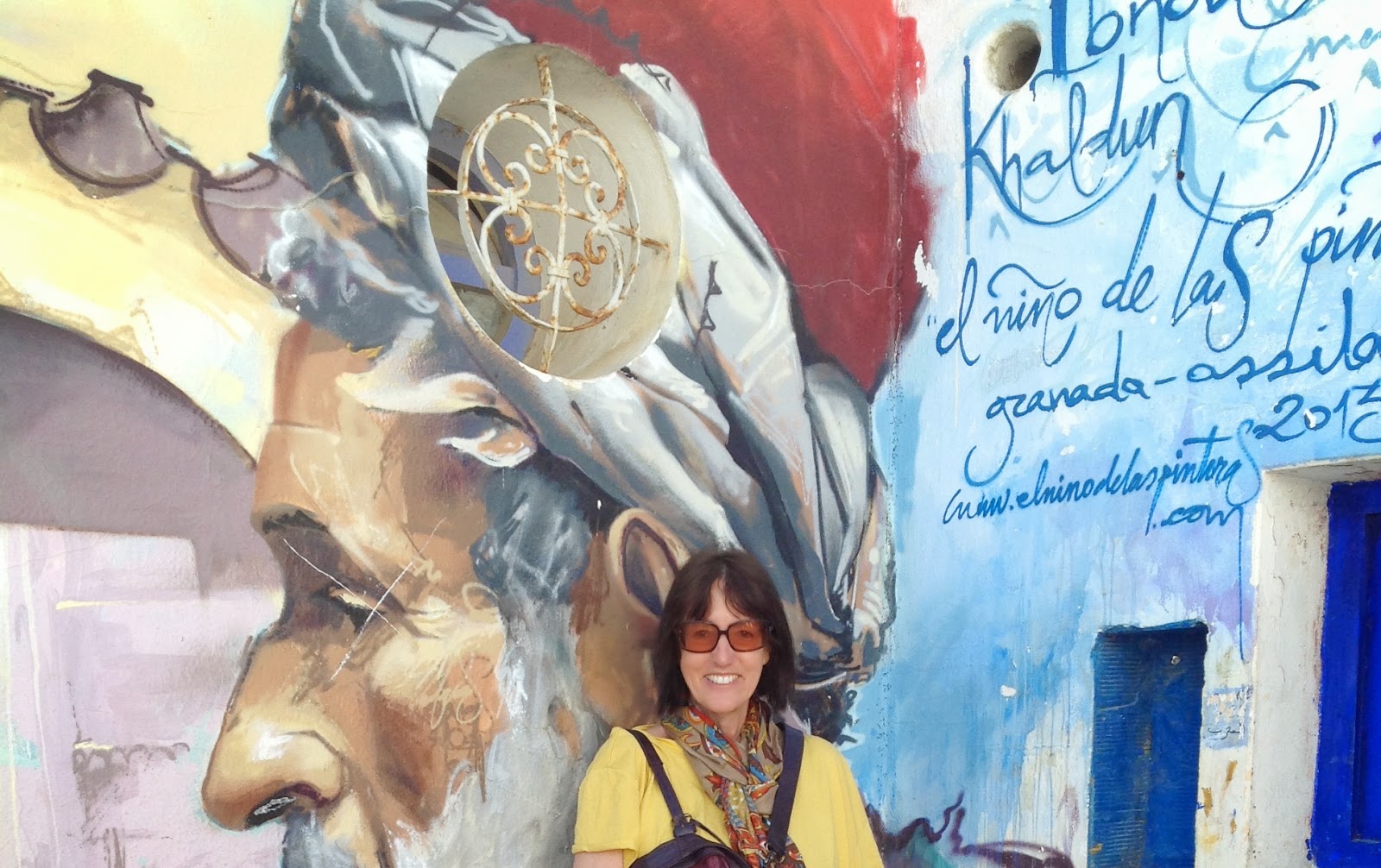
An enormous painting on a wall in Asilah

On the Sahara--practical, yet beautiful, another simple style 
 Another style worn by a Gnawa musician, a descendent of
Sudanese slaves, in the village of Khamlia


I never know how my dear friend, Ali, will fashion his turban while in the desert, but I know it will always be beautiful--and practical                                                                                                             


As for me...I always wear one when I go out on a camel trek for an overnight in the desert...and it always comes in handy as protection from the elements.  Plus, I am just silly enough to enjoy the costume effect it has for foreigners like me.  I may feel part Moroccan in my heart, but yes, I am still a tourist.


 From a couple of years ago...
From last spring...
Tye-dye (I couldn't help myself...) from a few years back


From this past October...I fear I may be opting for more outrageous fabrics each year...My husband thought this one over-the-top


Parting Shot:
In October with my friend Ahmed, whose turban fabric I probably need.  Nay, definitely need.


©Victoria Challancin.  All Rights Reserved.

Flavors of the Sun International Cooking School and Travel
San Miguel de Allende, Mexico


Friday, July 18, 2014

Moroccan-Inspired Chicken Patties with Date Confit--and More Photos from Morocco

Moroccan-Inspired Chicken Patties with Date Confit


Moroccan-Inspired Chicken Patties with Date Confit--and More Photos from Morocco
by Victoria Challancin

No one has said it better than food maven Paula Wolfert, who wrote so thoroughly and so lovingly about Morocco and its heady cuisine.  To paraphrase her, Moroccan food is spicy, but not really piquant.  If you want chile heat, you simply provide the rich condiment called harissa (see my recipe and article here) at the table, to be passed separately so that diners can add the piquancy they want.  But the actual use of spices in Moroccan cuisine is always judicious, as if each cook knows just the perfect amount of each spice required to enhance her dish, without ever overwhelming the whole, without ever allowing one note to dominate the harmonious union of the seductive blend of ingredients.

Although you might never find this particular dish in Morocco, the flavors are true to the cuisine, resulting in a rich, thoroughly modern interpretation of Moroccan flavors.  Using a spice blend called ras el hanout to enliven the chicken patty and a pomegrante molasses-rich confit of dates to round out the flavors, this recipe is a wonderful way to experience the flavors of Morocco.


Cook's Notes:  This is such a lovely recipe as written that I don't think I even tampered with it, a rare thing for me.  And if you are lucky enough to have leftovers of this dish, the taste just improves the next day.  My sister-in-law made these for a party appetizer and served them with my Chermoula Sauce (see my recipe here and lots of ideas for how to use it here), which also worked beautifully.  Lovely flavors.  Did I skip the cucumber and onion relish?  I can't imagine that I did, but then, I don't see it anywhere.  Just cilantro leaves.  Yikes!


Recipe:  Moroccan-Inspired Chicken Patties with Date Confit
Serves 4 as a light meal and up to 12 as an hors d'oeuvres

For the chicken patties:
1 1/2 pounds boneless, skinless chicken breast halves (I purchase pre-ground)
4 garlic cloves, finely chopped
1-inch piece fresh ginger root, peeled and grated
2 teaspoons Ras el Hanout (see my recipe here)
3 tablespoons olive oil
1/2 teaspoon light brown sugar

For serving:
16 small hearts of lettuce leaves
4-inch piece English cucumber, quartered lengthwise, seeded and diced
1 small red onion, finely chopped
1 handful cilantro leaves

For the date confit:
20 ready-to-eat pitted dates, halved (use Medjool, if possible)
1 tablespoon olive oil
2 shallots, chopped
1/2 teaspoon ground cinnamon
1 Thai (or serrano) chile, finely chopped
1 teaspoon light brown sugar
2 tablespoons pomegranate molasses
Sea salt and freshly ground black pepper

To make the date confit:
Put the dates in a bowl, cover with just-boiled water and leave for 1 hour.  Meanwhile, heat the olive oil in a skillet and fry the shallots, covered, for 20 to 25 minutes or until very soft.

Drain the dates and add them to the pan, squashing them with the back of a fork to break them down.  Stir in 4 tablespoons water, the cinnamon, chile and sugar and cook for 5 minutes longer, or until it forms a thick jam consistency.  Add more water if it is too thick.  Stir in the pomegranate molasses and season to taste with salt and pepper. You can blend the mixture if you prefer a smoother consistency.  Spoon the confit into a serving bowl and allow to cool.

To make the chicken patties:
Heat the oven to 100 degrees.  Grind the chicken in a food processor (or use pre-ground, as I did), then stir in the garlic, ginger, and ras el hanout.  Season to taste with salt and pepper.  Form the chicken mixture into 16 equal balls, about the size of golf balls.  Flatten each one to make a little patty.

Heat two-thirds of the oil in a large nonstick skillet over medium heat.  Fry the patties, in two or three batches, if necessary, for 3 minutes on each side.  Just before they finish cooking on each side, sprinkle with a little sugar and cook until slightly caramelized.  Drain on paper towels and keep warm in the low oven while you cook the remaining patties, adding more oil as necessary.

For serving:
Put a chicken patty on top of each lettuce leaf, scatter a little cucumber, red onion and cilantro over and top with a spoonful of the date confit.  Serve warm or at room temperature.


                                    Moroccan-Inspired Chicken Patties with Date Confit


           More Images from my Moroccan Trip in April 2014:


Like what you see?  Why not join me in either October of 2014 or April of 2015 on my next tours of Morocco--beautiful, seductive Morocco.


©Victoria Challancin.  All Rights Reserved.

Victoria Challancin
Flavors of the Sun Cooking School and Trips
San Miguel de Allende,
México

Sunday, February 23, 2014

Mushroom Kofteh with Green Harissa

Vegetarian Herb-Laden Mushroom Kofteh with Green Harissa Sauce 


Mushroom Kofteh with Green Harissa
by Victoria Challancin

In honor of the upcoming tour I will lead to Morocco in April, I thought it was time to give a nod to a Moroccan recipe--or vaguely a Moroccan recipe.  Or a Persian recipe with a Moroccan sauce.  Perhaps I should say a "modern take on two iconic recipes from Iran and Morocco."  I could even just offer this delightful recipe up to you as a modern vegetarian recipe from my imaginary World Cafe.   

These mushroom patties, or kofteh (usually kefteh in Morocco), are a lovely vegetarian riff on the classic grilled meat patties known all over the Middle East, Near East, East Asia,  and North Africa.  Meat kofteh (spellings vary greatly) are generally redolent with garlic and fresh herbs as is this lovely vegetarian version by Chef Hoss Zaré, who features his native Persian cooking and modern interpretations of it in his Flytrap restaurant in San Francisco.  Remaining true to the Persian love of fresh herbs, Zaré offers here a rich, but light, vegetarian version of the classic grilled street food, but pairs it with another riff on a classic recipe, this time harissa, the staple red table sauce in Tunisia and Morocco.

For more information about harissa, click on my article Harissa:  A North African Condiment.  In this post I show you lots of photos of how harissa appears on the tables and in the markets of Morocco, along with a bit of history and my own personal recipe for a more traditional red harissa, which I developed over the years on my many journeys in Morocco--plus with a little help from my lovely friend Latifah.  If you like a bit of spice and kick to your food, you might just find yourself becoming addicted to this lively table condiment, no matter whether it is red or green!


 Mushroom Kofteh with Green Harissa

Cook's Notes:  The original recipe also includes an asparagus pesto, which I am certain would be delicious.  I thought, given the rest of my menu, that it might be gilding the lily, so I simply eliminated it.  Do check it out, though, as it looks tasty!  I used crimini mushrooms rather than a mix as that is what I easily found at the store.

Recipe:  Mushroom Kofteh with Green Harissa
(Adapted from a recipe by Hoss Zaré for Food and Wine Magazine)
Serves 8

2 tablespoons extra-virgin olive oil, plus more for brushing
1 1/2 pounds assorted wild mushrooms, such as oyster and stemmed shiitake, thinly sliced (8 cups)
Salt
1 cup panko (Japanese bread crumbs)
1/2 cup freshly grated Parmigiano-Reggiano cheese (2 ounces)
1/2 cup chopped flat-leaf parsley
2 tablespoons chopped basil
2 tablespoons fresh lemon juice
1/4 teaspoon cayenne pepper
2 large eggs
2 large egg whites
Green Harissa (see the following recipe) for serving

In a nonstick skillet, heat the 2 tablespoons of olive oil.  Add the mushrooms, season with salt and cook over moderately high heat, stirring occasionally, until softened and lightly browned, about 12 minutes.  Transfer the mushrooms to a work surface and let cool slightly, then coarsely chop.  Transfer the mushrooms to a large bowl.  Add the panko, cheese, parsley, basil, lemon juice and cayenne and season with salt.  Add the eggs and egg whites and knead the mixture to combine.

Line a baking sheet with parchment paper.  Using lightly moistened hands, form the mushroom mixture into six 1-inch-thick patties and set them on the baking sheet.  Refrigerate until firm, about 1 hour.

Preheat the oven to 350 degrees F.  Preheat a grill pan or a griddle, preferable nonstick, and brush with olive oil.  Brush the kofteh with oil and grill over high heat, turning once, until browned, about 5 minutes.  Return the kofteh to the baking sheet and bake for 10 minutes, until hot throughout.  Serve the kofteh with Green Harissa.


 Mushroom Kofteh with Green Harissa

Recipe:  Green Harissa
(Recipe by Hoss Zaré for Food and Wine Magazine)
Makes 1 cup

1/2 packed cup baby spinach leaves
1/2 packed cup flat-leaf parsley leaves
1 teaspoon smoked paprika
1/4 teaspoon ground cumin
1/8 teaspoon ground cardamom
1 1/2 teaspoons ground coriander
2 small jalapeños, seeded and coarsely chopped
2 garlic cloves
1/2 teaspoon finely grated lemon zest
1/2 teaspoon finely grated orange zest
2 tablespoons fresh lemon juice
1 tablespoon fresh orange juice
6 tablespoons extra-virgin olive oil
Salt and freshly ground pepper

In a blender pulse the spinach, parsley, paprika, cumin, cardamom, coriander, jalapeños garlic, lemon zest, orange zest, lemon juice and orange juice until the greens are chopped. With the machine on, add the oil and puree.  Season with salt and freshly ground black pepper.


Mushroom Kofteh with Green Harissa


For information about the international tours I lead each year (cultural rather than culinary--though with lots of great food!), email me.

Parting Shots:

Paris Tour:  April 13-20, 2014
 I'll be having tea here soon!

Morocco Tour:  April 23-May 8, 2014
 That's a turban-wrapped me on the lead camel, taking this photo in 2013!

©Victoria Challancin.   All Rights Reserved.

Please ask permission before using photos or text.  Thanks!


Wednesday, November 27, 2013

Baked Halibut with Chermoula and Pistachio Couscous


Photograph by Zachary Popovsky

Baked Halibut with Moroccan Chermoula Sauce

by Victoria Challancin

Touching their hearts to show their sincerity, my favorite Marrakshi (people from Marrakech) vendors greet me, "Salaam Aleikum, Mrs. Bahrain."  I am hoping it is a compliment, but I could be optimistic.  You see, the broad vowels of the Arabian Gulf, where I lived for many years, overshadow the soft, delicate ones of derija, the Arabic spoken in Morocco.  And although after having led so many groups to Morocco over the years (see below for information), I do understand that Morocco is a Berber country rather than an Arab one, yet I still haltingly trip over my rusty Arabic, clinging as I do to the broad, deep vowel sounds I studied so hard to replicate many years ago while living in Abu Dhabi and Bahrain.  It is rather like my Southern accent, it is a permanent part of my linguistic being.

And thus we come to the word "chermoula."  Chermoula...that delectable, gently spiced herby marinade/sauce beloved in Morocco with good reason.  Full of fresh herbs and sparkling spices, it fairly sings in the mouth, encouraging you to reinvent it, to find more uses for it, to make it a staple in your repertoire of condiments.  I first learned to call it "charmoula," emulating those beloved sounds of the Gulf countries.  Gradually, I realized that "chermoula" was closer to the softer Arabic spoken in Morocco.  Subsequent research showed me that countless recipes are available online under either name or even occasionally called "chrmla".


Cook's Notes:  Shulman suggests using a food processor for ease, as I did, but notes that in Morocco the ingredients would be chopped finely by hand or even with a mortar and pestle.  Thin it with olive oil and/or lemon juice, if you prefer.  Use it on fish fillets or whole fish; bake it in the oven, grill it over charcoal, or bake it in the oven.
Recipe:  Baked Halibut with Chermoula
(Recipe by Martha Rose Shulman for the Recipes for Health Column in the New York Times)

1 1/2 to 2 pounds firm white fish fillets, such as halibut, mahi mahi, or striped bass
Salt and freshly ground black pepper
1 recipe for chermoula (recipe follows)
Additional lemon juice and wedges or olive oil to taste

Season the fish with salt and pepper.  In a large baking dish combine the fish with half the chermoula and toss together until the fish is coated.  If the chermoula is thick, it may be easier to spread it onto the fish with a spatula.   Refrigerate for 15 to 30 minutes while you preheat the broiler or oven, or prepare the grill.

If using a broiler, line a sheet pan with foil and brush the foil with olive oil, or oil a shallow baking dish for use in the oven.  Place the fish in the pan in a single layer.  If desired, drizzle on a little more olive oil or lemon juice.  Place under the broiler, close to the heat (about 2 1/2 inches) and broil 5 minutes.  Check the fish; the timing depends on how thick the fillets are; figure on 4 to 5 minutes per 1/2 inch of thickness.  It is done when it is opaque and you can pull it apart with a fork.  Using a spatula, transfer the fish from the sheet pan or baking dish to a platter or to individual plates.  Tip the juices in the pan over the fish fillets.   Pass the remaining chermoula and lemon wedges at the table.

Note:  You can also bake the fish in a preheated oven (375 degrees F).

Advance preparation:  The chermoula will keep for a few days in the refrigerator, but it will lose its vibrant green color.

Martha Rose Shulman's Chermoula
2 cups cilantro leaves
1 1/2 cups parsley leaves
3 to 4 garlic cloves (to taste), halved, green shoots removed
1/2 to 3/4 teaspoon salt (to taste)
2 teaspoons cumin seeds, lightly toasted and ground
1 teaspoon sweet paprika
1/2 teaspoon coriander seeds, lightly toasted and ground
1/8 teaspoon cayenne (more to taste)
1/3 to 1/2 cup extra virgin olive oil, to taste
1/4 cup freshly squeezed lemon juice

Coarsely chop the cilantro and parsley. Scissors are good for this.  Place them in a food processor and chop very fine, or chop on a cutting board.  You should have 1 cup finely chopped herbs.

Place the garlic and salt in a mortar and puree.  Add a small handful of the chopped herbs, and gently but firmly grind until the herbs begin to dissolve.  Add another handful.  When all of the herbs have been mashed, work in the spices, 1/3 cup olive oil and lemon juice.  Taste and adjust seasoning.  Add more olive oil or salt if desired.  Served with grilled fish and/or vegetables, or with chicken.

Yield:  Makes approximately 1 cup

My version of chermoula from my friend Latifa prepared for another occasion

Recipes from Flavors of the Sun using Chermoula:
More ways to use Chermoula:
  • On chicken or pork
  • With kebabs
  • On any roasted or steamed vegetable (vegetables can be roasted with the chermoula as marinade)
  • In couscous or rice--or with any grain as a side or in a salad
  • As a dipping sauce for flatbread or raw vegetables
  • In yogurt
  • Poured over feta or goat cheesee--or other cheese of choice
  • With grilled haloumi or panela cheese
  • With lentils, garbanzos, or cooked dried beans
  • With sturdy salads
  • With seafood--cooked or raw (as in ceviche or even sushi)
  • Variations:  add saffron, preserved lemon, onion, fresh chiles, tomatoes (though my MOroccan friends tell me tomatoes aren't included
  • Serve over a caprese-style salad without the basil
  • Use as a marinade for seafood, especially shrimp, or a sauce/dressing
  • Make a squid salad dressed with chermoula
  • Toss it into a pasta salad
  • Add a dash to an egg or tuna salad
  • Add a splash to soup (bean, potato, minestrone, etc)
  • Use as a dipping sauce for Moroccan-style eggrolls
  • Use your imagination!  This recipe won't disappoint!


Cook's Note:  Because the chermoula is so rich and flavorful, I chose a simple side dish of couscous that I found on the terrific, always inspiring Australian food site www.taste.com.au.

Pistachio Couscous with Chickpeas and Fresh Herbs

Recipe:  Pistachio Couscous
(Recipe from www.taste.com.au)

1 cup (200g) couscous
1 cup (250ml) hot chicken or vegetable stock
2 tablespoons chopped flat-leaf parsley leaves
2 tablespoons chopped coriander (cilantro) leaves
1 garlic clove, crushed
2 tablespoons pistachios, chopped
400g can chickpeas, rinsed, drained
2 tablespoons lemon juice, plus wedges to serve

Place the couscous in a heatproof bowl and pour over the hot stock.  Cover and let stand for 5 minutes, then fluff the grains with a fork.  Stir in the herbs, garlic, nuts, chickpeas and lemon juice. Season to taste and set aside.
A plate of Moroccan Salads I made for a dinner party with Chermoula in the center and on the cauliflower and potato cakes

For more information about my 2014 Morocco Tour, April 23-May 8, contact me at flavorsofthesun@gmail.com


 Parting Shot:  Moroccan Carpet Fun

Parting Shot II:  The Sausages of France

For more information about my 2014 Paris Tour, April 13-20, contact me at flavorsofthesun@gmail.com


©Victoria Challancin.  All Rights Reserved.

Please ask permission before using text or photos.  Thanks!