Blog Archive

Showing posts with label México. Show all posts

Sunday, August 16, 2015

Shrimp with Vanilla Beurre Blanc on Cardamom-Coconut Rice and Mariachis!


 Shrimp with Vanilla Beurre Blanc on Cardamom-Coconut Rice and Mariachis!
by Victoria Challancin

For those of you who don't live in Mexico, the thought of vanilla with seafood might seem odd.  Odd, indeed!  But over time, given that vanilla originated in the jungles near Veracruz, Mexico, and the fact that Mexico has well over 9000 km of coastline...well, the marriage of the two seems inevitable here, and it is no wonder it found its way to the world of alta cocina, or the haute cuisine of my adapted home.  And what a lovely coupling it is!  Vanilla lends a spicy nuance, a hint of mystery, a note of exotica to almost any dish it enhances, but the sheer beauty of it sings when paired with wine and butter as it is in this dish.

Cook's Notes:  I decided to double up on the amount of tomato, which in retrospect was a mistake, as it soaked up a bit too much of the beurre blanc.  A tablespoon would have been just right.  In fact, the next time I make this, I will double the amount of the beurre blanc instead!

Shrimp with Vanilla Beurre Blanc on Cardamom-Coconut Rice

(Recipe from McCormick’s Gourmet Kitchen)

Serves: 6

3/4 cup coconut milk
1/4 cup water
1/4 teaspoon ground cardamom
1/4 teaspoon sea salt
1/2 cup jasmine rice
2 tablespoons chopped green onions
1/2 cup (1 stick) cold butter, cut into 8 (1 tablespoon) pieces
1/4 cup finely chopped shallots
1/2 cup white wine
1/4 teaspoon sea salt
1 (3-inch) piece of whole vanila bean
2 tablespoons heavy cream
2 tablespoons finely chopped seeded plum tomato
12 jumbo (16 to 20 count) shrimp, peeled and deveined, leaving tails on
1/4 teaspoon sea salt
1/4 teaspoon coarsely ground black pepper
1 tablespoon butter
 For the Cardamom Coconut Rice, bring coconut milk, water, cardamom and sea salt to boil in medium saucepan, stirring occasionally. Stir in rice. Reduce heat to low; cover and simmer 20 minutes or until rice is tender, stirring occasionally to prevent rice from sticking. Fluff rice with fork. Add green onions; toss gently to mix. Set aside, keeping warm. 
Meanwhile, for the Vanilla Beurre Blanc, melt 1 tablespoon of the butter in small saucepan on medium heat. Add shallots; cook and stir 5 minutes or until softened. Stir in wine and sea salt. Split vanilla bean in half lengthwise. Scrape seeds into saucepan. Bring to boil. Reduce heat to low; simmer 15 minutes or until liquid is reduced by half. Stir in cream. Return to simmer. Gradually add remaining cold butter, 1 tablespoon at a time, whisking to form a creamy sauce. Stir in tomatoes

For the Shrimp, season shrimp with sea salt and pepper. Melt butter in large skillet on medium-high heat. Add shrimp; cook and stir 3 minutes or just until shrimp turn pink.

To serve, place a 2-inch diameter biscuit cutter in the center of a small plate. Press 1/4 cup of the rice mixture into biscuit cutter to form a rice cake. Gently remove biscuit cutter. Top center of rice cake with 2 shrimp. Spoon 2 tablespoons beurre blanc over shrimp and around rice cake. Repeat with remaining rice, shrimp and beurre blanc.


 Los Mariachis
Influenced by both polkas and waltzes, mariachi groups now include such instruments as the violin, guitar, harp, woodwinds, trumpet, guitarrón and the high-pitched vihuela, round-backed guitar which provides rhythm, although in the beginning, only string instruments were used. Originally a form of folk music called Son Jaliscience, designating its origins near Guadalajara in the state of Jalisco, this regional style of music migrated from the countryside to the urban centers of Guadalajara and Mexico City as workers began flocking to the cities in the early 1900s looking for work.  What began as a local gathering of musicians/farmworkers, evolved into a sophisticated collection of talented musicians who became an essential part of the national identity.

Eventually, the evolution even included the gradual changing of its name to mariachi.  The name mariachi itself is thought to have derived from the French word marriage, dating from the 1860s when French influence in Mexico was at its height.  Other stories claim it comes from the name of an indigenous tree—or possibly from a local persona called “Maria H,” which would be pronounced Mari-Ache.  Whatever the provenance of the name and the music, both are firmly planted now in the consciousness of the nation.  As a regional folk music from Jalisco, or possibly even Colima, Nayarit and even Michoacán, it has been transformed over time into a national phenomenon, a popular treat for all at family celebrations, political events, and restaurants, a part of the national identity and a mark of great pride. 


On this occasion, the 65th birthday of our close friend, his staff hired the mariachis as a surprise to play poolside at a small gathering of friends who gathered at his house to celebrate his birthday.  What started out as a festive display of familiar Mexican tunes which were familiar to all, slowly evolved into a touching serenade of haunting melodies, which strummed gently at my heart as the musicians paid tribute to a loving man and dear friend.


And what birthday party would be complete without...
the Music...
 Malequeña


A violin solo...


Handblown Mexican glasses...

 Flowers...

 And a birthday cake...

Parting Shot:

©Victoria Challancin.  All Rights Reserved.

Flavors of the Sun Cooking School and Travel

San Miguel de Allende,
México


Monday, December 22, 2014

Food Truck Weekend


Before I begin this blog, I would like to offer sincere warm wishes of good health and peace to each of you and your families during this Holiday Season and for 2015.  I appreciate your support always.   

Food Truck Weekend
by Victoria Challancin

While Mexico has a long history of food stalls, or puestos, the concept of actual food trucks has been slow to take off.  Happily for me, it looks like that is changing.  Puestos do indeed have a long history here in Mexico, and hopefully are firmly and permanently entrenched in this culture as a quick, economical way to approach every sort of food.  Whether located in the local market or as something that springs up in the streets in the evenings, these food stalls serve the people well.  You can find specialty foods from modern hamburgers and hot dogs, to rich pozole (a hominy-based soup that comes in three colors with a glory of condiments), the ubiquitous taco in its many forms, empanadas, tortas (sandwiches), tostadas, corn, atole (a rich corn-based drink), aguas frescas, chorizo, frijoles, tamales, mariscos (seafood), huaraches (a shoe-shaped corn-based sort of open-faced taco), menudo (tripe soup/stew thought to be good for hangovers), antojitos (corn-based snack food which includes gorditas, tamales, tostadas, and more) grilled meats such as arrachera, and guisados (stews) made with everything imaginable.  The world of food-stall food is mind-boggling...and utterly delicious.  

I laughingly remember when my son returned from studying his last year of high school in France, I asked him rather foolishly what kind of food he had missed.  That is to say, what did he long for from Mom's kitchen.  Imagining that he might ask for lasagna or shepherd's pie, or some other favorite, I was a little taken aback by his response:  "Oh, Mom...tacos de cabeza y una torta con milanesa y tajín!"  Goat head tacos and sandwiches made of breaded thin chicken or pork with all the trimmings.  So much for Mom's cooking.  So it was off to the puestos for him, and my son, like most Mexicans, knew just where to turn for his favorite fix.

On December 13th and 14th San Miguel de Allende held its first Food Truck Weekend, which promised Comida-Arte-Diseño-Moda...all rolled into one event.  And it didn't disappoint.  While San Miguel only has two food trucks that I know of, neighboring Querétaro, which is a much larger city, has burgeoning food truck installations popping up everywhere.  Our small event, in fact, featured both of San Miguel's food trucks and five others from nearby Querétaro.  All were spotlessly clean and peopled with smiling entrepeneurs looking to expand their reach.

Here is a sampling of what the event had to offer:


With its smiling patron in a Frida Kahlo t-shirt, dressed in pink to match her truck, the CB Bakery offered sandwiches, milkshakes, caramel popcorn, and their popular cheese cake, which was sold out.

To give you an idea of prices, in case you aren't a local reader, there are approximately 14.5 pesos to one US dollar, reflecting both the pesos recent decline and the dollar's surge.  So that makes a hamburger cost about $4.15 and a hot dog about $1.40.  Just so you have a point of reference.


The Chef on Fuego, or "Chef on Fire," particularly interested me as I had heard that the restaurant that sponsors it features really excellent lamb.

Here is the friendly and knowledgable Chef on Fire himself

Happy to accommodate, the chef sent an employee to the mother restaurant, which was only fifty feet away so I could have a menu to take home.  In addition to reasonably-priced breakfasts (Hot cakes, French toast, any style of breakfast eggs, and chilaquiles (my absolute favorite Mexican breakfast), and huaraches with many toppings (mentioned above)--ranging from 45 to 69 pesos, or $3 to about $4.75, he also features the more substantial dishes he is known for:  BBQ ribs ($8.30) and pulled pork sandwiches ($6.50).  Baby back ribs, wings, hamburgers, hot dogs (fancy ones!), flautas, and even two pasta dishes also are available. Yum.

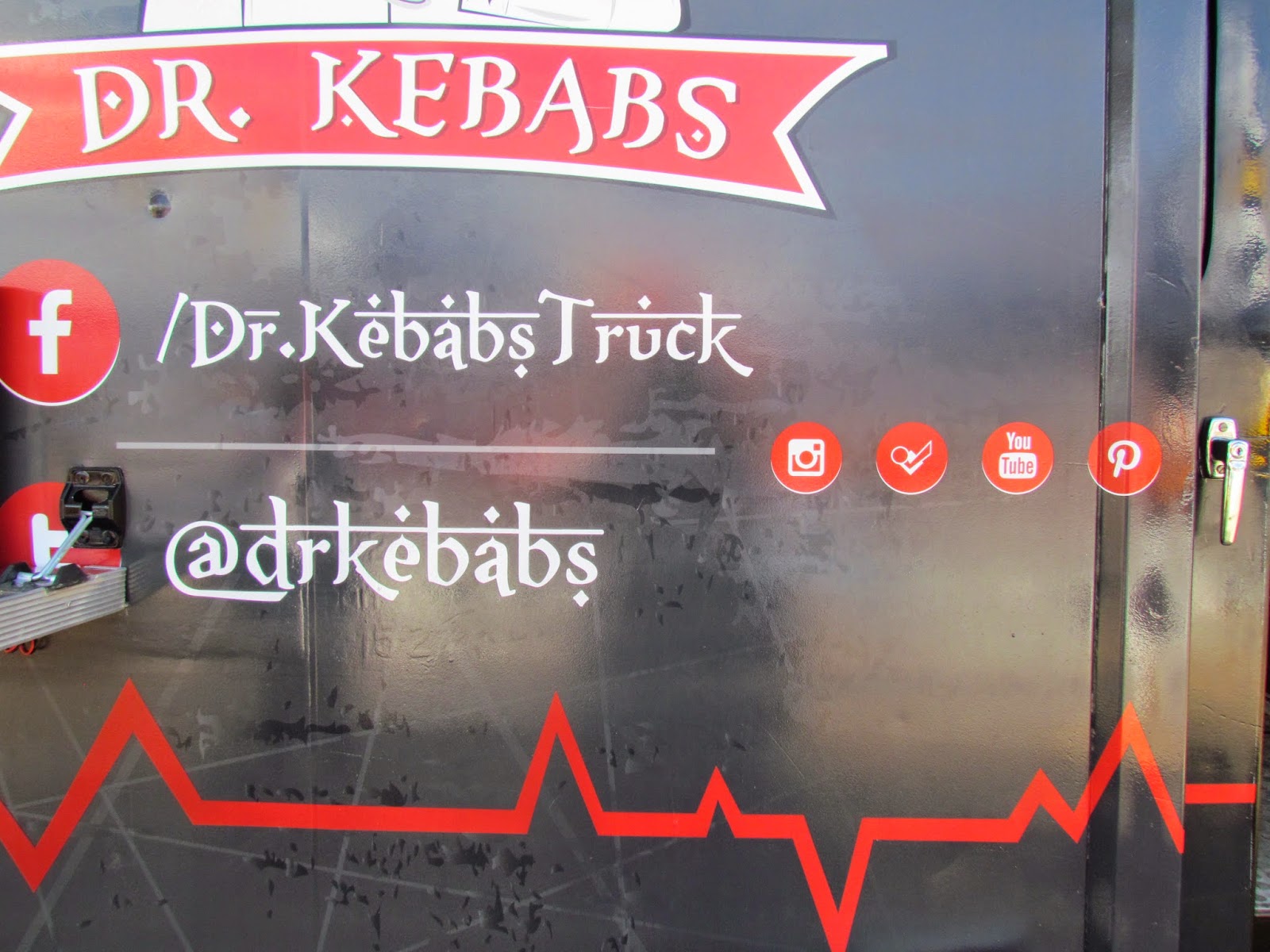
Of course Dr. Kebabs' truck pulled me over right away, given my love of Middle Eastern food.

I had to smile at how modern we have become with social media...even for food trucks.  Of course.  It's important stuff, I do realize.


Shawarma, much like Mexico's tacos al pastor, a terrific offering of marinated meat shaved with a special machine in the modern way
No Mexican food event would be complete without a table offering the beloved michelada, a beer-based libation made with beer (and Mexican beer is soooooooo very good), lime juice, chile, and several sauces.  Loosely translated, michelada, means "my cold beer."  Variations abound, such as one of my favorites that was introduced to me by my son, called Cielo Rojo, or Red Sky, which uses clamata juice and V-8.  In the above photo you can see salt, Worcestershire sauce (salsa inglesa, English sauce), and the popular salsa Maggi, a hydrolysed vegetable protein-based seasoning sauce similar to soy sauce, but without containing any soy--all used in a proper  michelada. 

Lemon juice and chile to rim the glass or, in this case, cup

When I asked the lovely young woman who was turning out the micheladas if the red powder was Tajín (a beloved chile/lime/salt seasoning used on just everything, especially tortas and cold fruits and vegetables such as cucumber, jícama, and mango), she told me it was best to use this blend, and had me taste it.  Yes, indeed, it was better--rich and slightly sweet with the taste of dried tamarind.  Yum, again.

Recipe:  Michelada
Cook's Note:  My son, who was born and raised in Mexico will be shocked and probably disappointed that I am including a recipe for michelada, but I do think my readers will want to have an idea of proportions--proportions that can be adjusted to taste, of course.  And should be.  This is how I learned to make it:

For one serving you need a lime and a small plate with coarse salt or a specific chile blend, such as the one above or Tajín

1/4 cup fresh lime juice
1/2 teaspoon Worcestershire sauce, or to taste
1/2 teaspoon Salsa Maggi, or to taste
A 12-oz bottle of Mexican beer of choice

To rim the glass with chile salt:  Cut the lime in half and rub around the rim of glass.  Invert the glass and dip in the chile-salt mixture.

Fill the glass with ice, if using, then add lime juice, Worcestershire sauce, and Maggi sauce.  Fill with beer.  Stir to combine.  Check and adjust seasoning


 This truck offered wings, burritos, and wraps--and a smiling young man eager to be helpful.  Although he had no actual menu, the chalkboard shows the types of burritos and wraps, plus salads and wings.


 The tiny puesto called Elocua, served gourmet corn.  Boiled and served with mayonnaise and queso fresco, esquites (or ezquites) are a popular street snack all over Mexico.

 Mayonnaise, plus popular sprinkles, mainly with chile


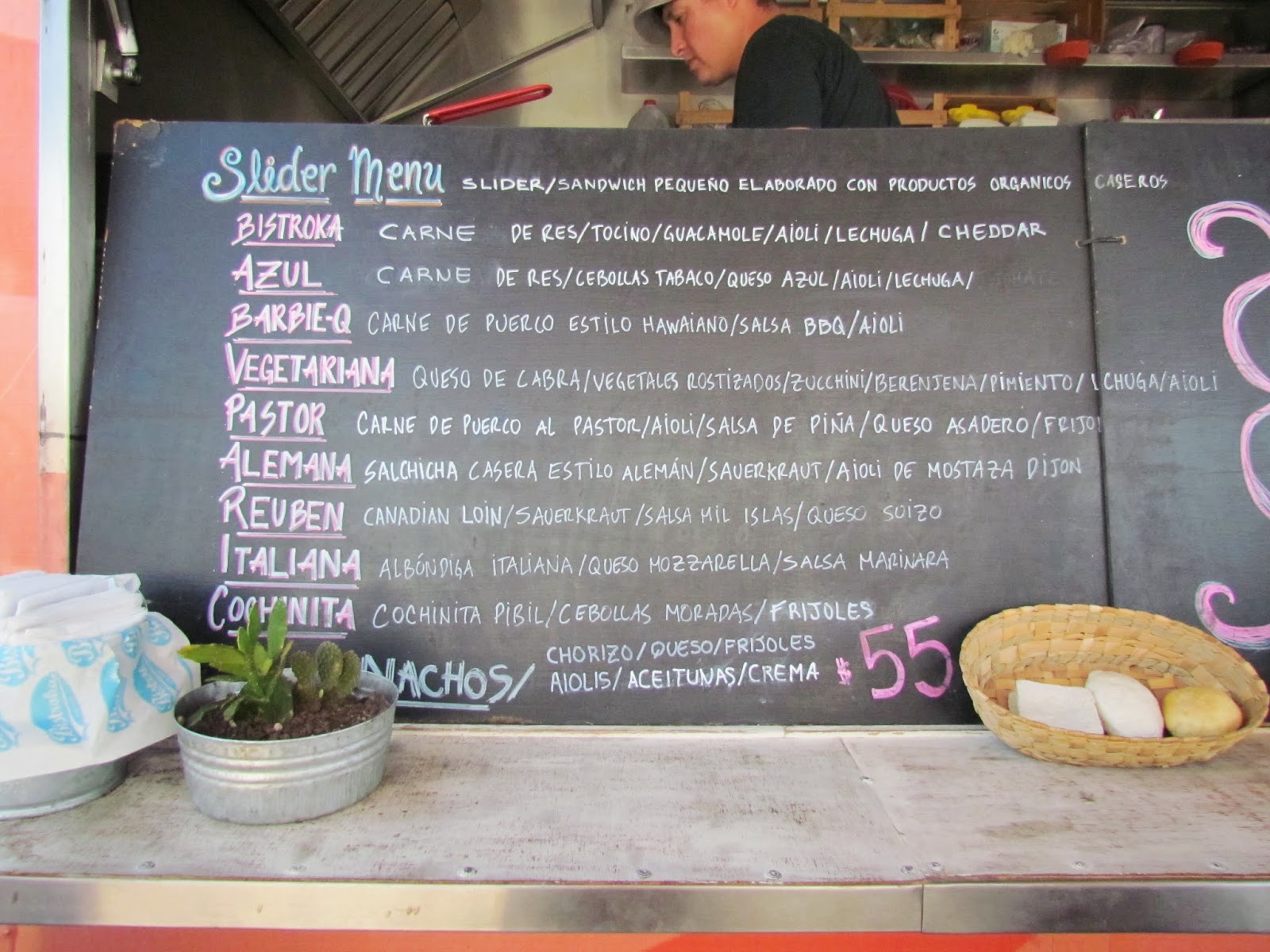
 Another truck that really grabbed my attention was Bistroka, a modern take on a fast bistro food, featuring a range of sliders with three bread options (see them in the basket?).  Unfortunately, I didn't really get a good photo of this truck, but I did nip a take-away menu, which shows that in addition to the slider menu below, they offer hamburgers, barbecue, Yucatecan cochinita pibil (an achiote- and sour orange-marinated chicken or pork dish), Italian-style meatballs, German brats, and even the beloved American Reuben sandwich.  And roasted vegetables with goat cheese for the vegetarians.


The other San Miguel truck, which is usually parked across the street from the Commercial Mexicana, or Mega, spotlights seafood.  You can see from the sign that they make empanadas with tinga a mild dish of shredded spiced chicken or pork) or crab. Also on the chalkboard menu are tacos of shrimp, tortas (sandwiches) of spiced pork, cod, or sirloin, tostadas of octopus or "beef feet", and pannacotta.  Of course.


Altomar (High Sea) is yet another truck which offered seafood, including caldo de camaron, the rich seafood broth so popular here, for basically $1 or 15 pesos.  [Note:  Mexico has the 13th longest coastline in the world, with 9930 km of coastline].  Their menu also includes tostadas de ceviche (several types), burritos, tacos, seafood hamburgers, and various sushis.   And more...always more.


What did I take home?
Because my husband stayed at home, I just had to make my orders "take-away" so I could share with him.  I don't have photos of all of the dishes, but here is what I ended up with:

  • A Philly Steak Slider
  • A Roasted Vegetable and Goat Cheese Slider
  • Octopus Tostadas
  • Crab Empanadas
  • A Mixed Middle Eastern Wrap of Shawarma and Falafel--and fries!
  • An order of Falafel
All good.  Each one.  Delicious.  And Chef on Fuego assures me that they are planning an even bigger event soon--and I can't wait!


 Octopus tostadas with guacamole...sigh...

Crab empanadas...sigh...yet again

©Victoria Challancin.  All Rights Reserved.

Please ask permission before using text or photos.  Thanks!

Victoria Challancin
Flavors of the Sun Cooking School
San Miguel de Allende, México